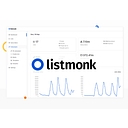
What is Listmonk and how does it work?
Listmonk is a self-hosted, open-source newsletter and mailing list management platform, deployed as a single binary application that you run on your own server or hosting infrastructure. It handles subscriber list management with segmentation, campaign sending, transactional messaging across email, SMS and WhatsApp, and campaign analytics.
Listmonk standout strengths
Being genuinely free with no licensing cost at all, under an open-source AGPLv3 licence, is the fundamental value proposition, and it is a real one for anyone with the technical capability to self-host. Every dollar a managed newsletter platform would charge per subscriber or per send simply does not exist here; your only cost is whatever server infrastructure you choose to run it on.
The demonstrated efficiency at real scale is genuinely impressive and worth taking seriously as a practical fact rather than a marketing claim: a production instance handling over 7 million sent emails on a fraction of one CPU core and just 57MB of peak RAM means even a small, cheap server can handle meaningful sending volume, keeping the actual infrastructure cost low as well as the licensing cost being zero.
Full data ownership and privacy control is a real, substantive advantage for anyone who specifically does not want subscriber data sitting on a third-party SaaS provider's servers, whether for genuine privacy principles, regulatory reasons, or simple risk aversion around a provider changing terms or being acquired.
Including transactional messaging across email, SMS and WhatsApp in the same tool as campaign sending is a genuine workflow convenience, avoiding the need for a separate transactional messaging service alongside your newsletter platform.
Listmonk weaknesses and drawbacks
The self-hosting requirement is the honest, central trade-off, and it needs to be weighed carefully against the zero licensing cost. Setting up, securing, updating and maintaining uptime for your own server infrastructure is real, ongoing work that a managed SaaS platform simply handles for you as part of what you are paying for. For someone without genuine technical comfort in this area, that work either needs to be learned or delegated, and either has a real cost even though it is not a licence fee.
There is no visual drag-and-drop design tool for building emails, which is a real gap against consumer-facing platforms built specifically around making that step approachable for non-technical users. Building well-designed campaigns here means working more directly with templates and HTML than a typical creator newsletter tool would require.
Deliverability being entirely your own responsibility deserves particular attention. Getting emails to actually land in inboxes rather than spam folders depends on domain reputation, correct SPF, DKIM and DMARC configuration, and consistent sending practices, all of which a managed platform typically handles more transparently and helps protect through their own established sending reputation. Self-hosting means you are building and protecting that reputation yourself from scratch.
Support is community-based, forums, documentation, GitHub issues, rather than a dedicated support team you can contact directly when something breaks, which matters more the less comfortable you are troubleshooting independently.
Listmonk pricing & plans (2026)
Free, open source, AGPLv3 licensed. No cost to Listmonk itself; your only expense is hosting infrastructure, which can be genuinely inexpensive given the software's demonstrated efficiency at scale.
This suits technically comfortable creators, developers, and organisations who specifically want full control and privacy over their subscriber data and are willing to handle their own infrastructure and deliverability management in exchange for zero licensing cost. It is a weaker fit for anyone without server management experience, and a weaker fit for anyone who values a polished visual design experience and dedicated support over cost savings and control.
Who is Listmonk best for?
| User type |
Why it fits |
Considerations |
| Technical creators and developers |
Full control, zero licensing cost, genuinely efficient at scale |
Requires real comfort with server setup and maintenance |
| Privacy-focused organisations |
Complete data ownership, no third-party SaaS handling subscribers |
Deliverability reputation is entirely your own to build and protect |
| High-volume senders on a budget |
Demonstrated efficiency keeps infrastructure cost low even at scale |
No managed support team if something breaks |
| Non-technical creators |
Weaker fit |
No visual design tool, requires self-hosting knowledge |
| Design-focused newsletter creators |
Weaker fit |
Managed platforms offer more approachable visual campaign building |
Listmonk review: final verdict
Listmonk delivers something genuinely rare: real, production-grade newsletter and mailing list software with zero licensing cost, demonstrated efficiency at serious scale, and complete data ownership, released as proper open source rather than a limited free tier of a paid product.
The trade is real and substantial for anyone without technical infrastructure experience: you are taking on the setup, security, deliverability management and support that a managed SaaS platform's fee would otherwise cover. That trade is a genuinely good one for the right technical user and a real barrier for anyone without that comfort.
4.4 out of 5 for the audience it is built for. An excellent, free, open-source option for technically capable creators and organisations who value control and privacy over managed convenience.